Blog

Ruby Wang

Fintechs are moving faster than traditional firms to put AI in front of customers, and the regulatory stakes rise with them. Once AI speaks to a customer, every answer is a statement the firm is accountable for, under the same rules as everything else it says. UK firms already use AI with customers, but a person still makes the call: in the Bank of England’s 2026 survey, no more than 9% of firms expect AI agents to approve or decline customer outcomes, even including planned use. The blocker isn’t autonomy itself. It’s autonomy without evidence.
Our survey of 200 senior leaders across UK financial services, the firms fintechs sell to, compete with and are benchmarked against, points to the gap. Only about a quarter would trust AI with customer communications under minimal oversight, 70% say compliance sign-off slows adoption, and few require a record of how each answer was reached.
Fintechs feel this first. Globally, 82% of fintechs surveyed use AI for customer support, against 67% of traditional institutions (Cambridge CCAF). Those that can evidence every answer will scale AI with customers faster.

AI is delivering returns, but trust runs out at the customer
More finance leaders report a positive return from AI than in other regulated sectors, although for most, these returns remain modest.

So far, most AI work happens where staff can check it before it reaches a customer. The next wave faces customers directly, and the FCA's Mills Review expects AI to reshape how consumers deal with financial services, including AI agents that act on their behalf and, over time, manage their finances within agreed limits (Mills Review summary). In December 2025, the FCA's chief data officer expected the first consumer-facing agentic AI to reach the market in 2026, and warned that Consumer Duty and the Senior Managers regime will be used to hold executives accountable (CeFPro).
This is actually where trust runs out. Asked which tasks their organisation would trust AI to do with minimal human oversight, only 26.5% of finance leaders chose customer communications. The issue is that without a record of how each answer was reached, every reply still needs a person to check it.

Customer-facing AI carries the full weight of regulation
Inside the firm, a wrong AI answer is an internal mistake. In front of a customer, it becomes the firm speaking, held to the same standard as everything else the firm says: fair, clear and not misleading. Under the FCA's Consumer Duty, firms must deliver good outcomes for retail customers, particularly vulnerable ones. The FCA now has 11 Consumer Duty investigations open, up from six, and has stopped some firms taking on new customers while they fix problems, which can lead to formal enforcement and required customer redress.
Accuracy is not enough: firms must show how an answer was reached
The FCA has chosen not to write a separate AI rulebook. Existing rules apply, and AI that cannot be explained to customers or supervisors is an enforcement risk. As WilmerHale puts it, ‘lack of explainability does not excuse non-compliance.’
Many finance leaders aren’t there yet. Of the 200 we surveyed, 115 do not trust AI completely, although most trust it somewhat. Asked what undermines their trust, beyond security, the next concerns are explainability (37%) and errors (34%), exactly what a regulator would probe.

Approval processes don’t close the gap. Before signing off on an AI solution, 32% of leaders say their compliance team requires accuracy thresholds and 27% require explainability evidence, yet only 18.5% require an audit trail. This matches what we said above: firms test whether AI is right, but few require a record of how each answer was reached.
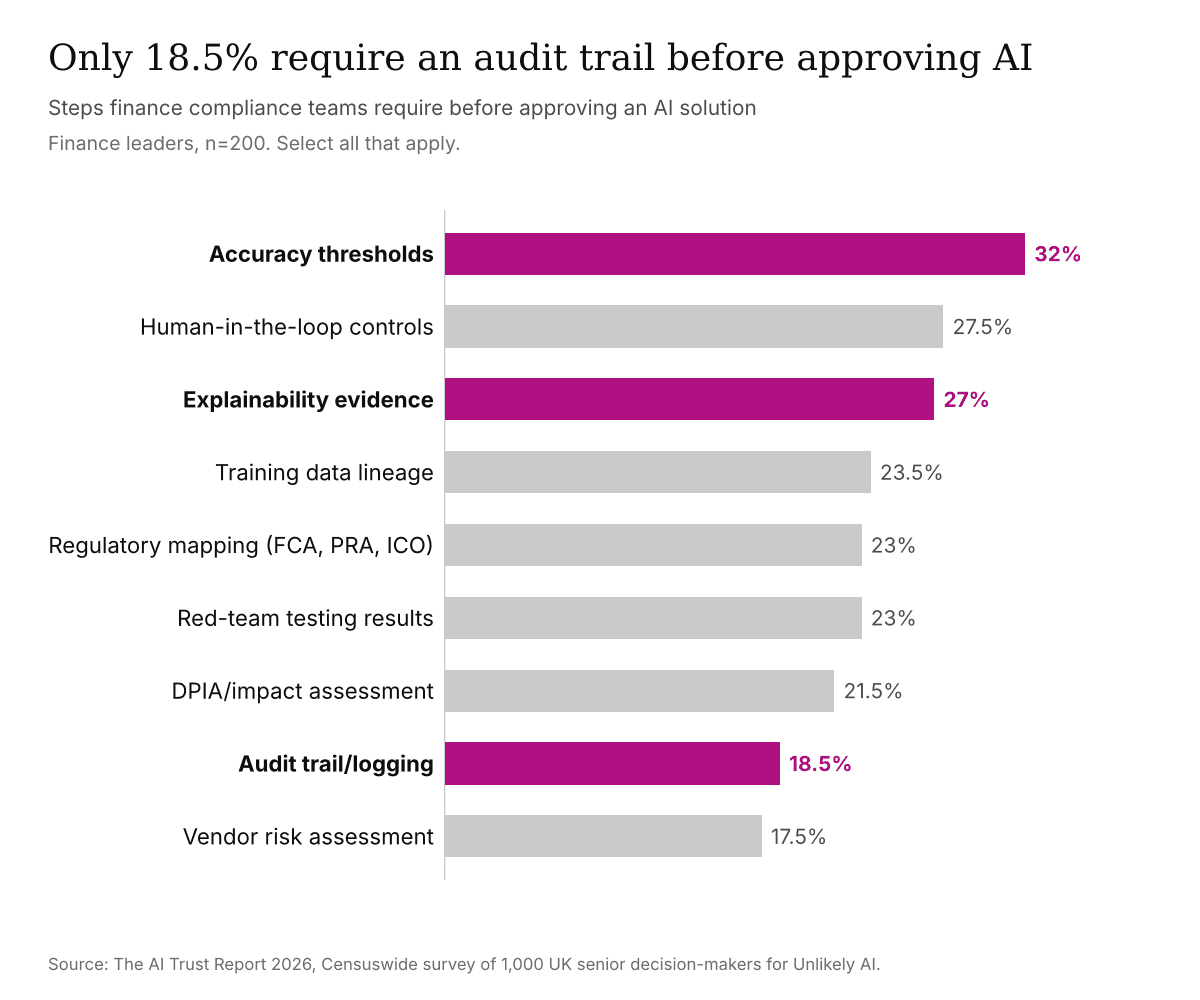
That record is what AI needs when facing customers. Every chatbot reply, complaint response and payment dispute needs to be consistent and explainable, case by case, because that is what the firm will be asked to show. With leaner teams than incumbents, fintechs have less room to absorb a failure, so that evidence has to be built in from day one.
Why risk and compliance leaders view AI risk differently
Risk and compliance leaders rank explainability as a top risk twice as often as technology leaders (33%, n=64, vs 16%, n=107). They are the people who answer to the FCA, so it is no surprise they feel this risk most.

This changes who must be convinced, and what they need to see. With 70% of finance leaders saying compliance sign-off slows AI adoption, the evidence has to convince risk and compliance. A lean team cannot review every output by hand either, so AI that delivers accurate, consistent and explainable answers by design lowers the review burden and makes approval easier to win.
The hardest test is the vulnerable customer
FCA guidance (FG21/1) defines a vulnerable customer as someone especially susceptible to harm because of their circumstances, such as illness, bereavement, low financial resilience or low capability. The signals are often buried in everyday language, so the expectation is that a firm spots them every time, slows down, avoids pushing products and hands over to a human.
AI struggles with exactly this test. When PensionBee asked four leading AI chatbots 45 pension questions, three times each, about one in ten answers (11%) was potentially harmful. On topics that could signal a saver in difficulty, potentially harmful answers outnumbered inaccurate ones by roughly three to one. An answer can therefore be accurate and still harm a vulnerable customer (PensionBee).
The FCA is already checking whether payments firms can spot vulnerable customers at all, even before AI is involved. Its latest review of payments and e-money firms found some that had identified very few or no customers in vulnerable circumstances, limited testing of whether their identification policies work in practice, and vulnerability data that was not consistently recorded (A&O Shearman).
Why AI answers are hard to evidence, and review cannot scale
Inconsistent answers, weak explainability and factual errors share a root cause in how most AI works today. Large language models generate a likely answer each time, so the same question can produce two different answers, and a wrong answer can sound as confident as a right one. Settings and guardrails can reduce the variation but not remove it. Asking the model to explain itself does not help either: it yields another generated answer, not a record of how the decision was made.
As a result, most reviews rely on sampling outputs and judging whether they look right. That works when staff check an answer before it goes anywhere. It becomes far harder when AI speaks to customers directly.
The burden falls on people. Finance leaders estimate the average employee spends about 2.6 hours a week checking or redoing AI work, close to the 3.1 hours they spend using it. Even at the top, the load shows: 35.5% of leaders say checking and rechecking AI answers is giving them burnout, and manual review cannot scale to every customer conversation. And when one answer does go wrong, the firm must explain that specific answer to the customer, to the Financial Ombudsman and, if it comes to it, to the FCA. A sample of other answers that looked right won’t help.
What changes if the problem is solved
We asked finance leaders what would change if an AI solution could guarantee accurate, consistent and explainable outputs for high-stakes tasks. Their answers:

More finance leaders prefer to keep people involved: 38.5% chose human-in-the-loop AI over full automation (25.5%). The goal is to let them focus on the exceptions, such as a vulnerable customer or an unusual case, instead of rechecking every answer. Firms that can do that will win sign-off faster and put AI in front of more customers.
Could you stand behind it? Five tests for customer-facing AI
Ask it the same question 100 times: is the answer the same every time, and can you prove it?
For any single answer, can you show exactly how it was reached, as a record rather than a generated explanation?
Who signed off this use case, on what evidence, and would they stand behind it in front of the FCA?
When a customer shows signs of vulnerability, does it spot them every time and hand it over to a human, and how do you know?
If the model changes tomorrow, how would you find out before your customers do?
Any question you cannot answer with evidence is where to start. For more findings about AI trust, download the full AI Trust Report 2026 [link], or book a 30-minute session to run these five tests on your own AI [link].
Methods note
Commissioned by UnlikelyAI, Censuswide surveyed 1,000 UK senior decision-makers with budget or decision authority for AI, at organisations with 250+ employees, between 26 November and 8 December 2025. Each sector had 200 respondents, and the finance sample (n=200) is UK finance as a whole, not fintech only. Differences described as higher or lower are statistically significant at 95%. Several questions allowed more than one answer, so percentages may not sum to 100%. Trust-undermining factors were asked only of the 115 finance leaders who do not trust AI completely. Weekly time spent using and checking AI is leaders’ estimate for the average employee, averaged from banded answers. “What would change” was a hypothetical question. Role groups: Tech = CIO, CTO, CISO, Head of Data and Head of AI (n=107); Risk and compliance = CRO, Head of Risk and Head of Compliance (n=64). Source for all Trust Report figures: AI Trust Report 2026 (Censuswide).
External sources: Cambridge CCAF 2026 Global AI in Financial Services Report for the fintech and incumbent comparison (203 fintechs and 149 traditional institutions across 151 countries), with figures as reported by FinTech Global; Bank of England, Artificial intelligence in UK financial services 2026; the FCA's Mills Review and a Mills Review summary; CeFPro on the FCA’s view of consumer-facing agentic AI; WilmerHale on the FCA's approach to AI; FCA guidance FG21/1 on vulnerable customers; A&O Shearman on the FCA payments firms review; Irwin Mitchell and BCLP on enforcement and redress; and PensionBee.