Blog

Maria Kuroedova
Three years into the generative AI era, the latest AI trust report researched across 1,000 senior leaders found only 22% are seeing real returns, meaning almost 80% are seeing limited returns. This raises a practical question about what differentiates the minority achieving meaningful ROI from the majority that is not.
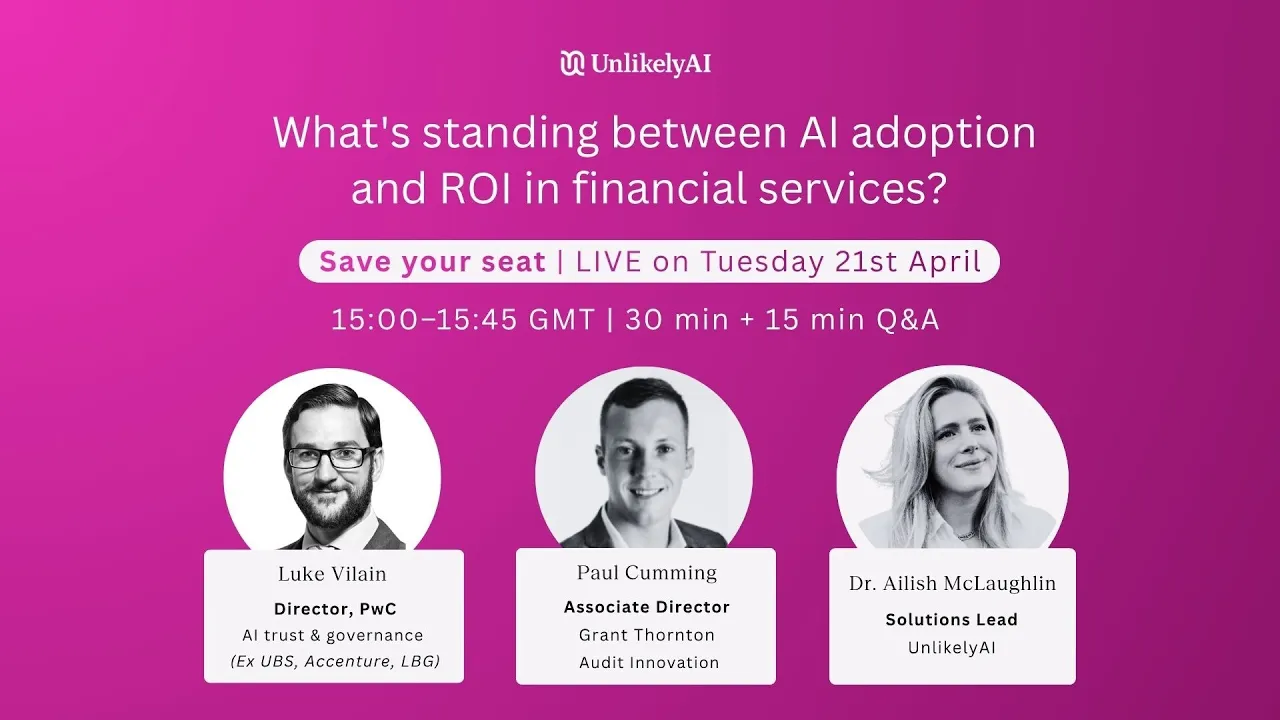
On 21st Apr, UnlikelyAI hosted a webinar to discuss the challenges financial services businesses face in achieving a true return on investment (ROI) from AI.
We invited Luke Vilain (Director at PwC, AI trust & governance expert, ex-UBS, ex-Accenture, ex-Lloyds Banking Group), Paul Cumming (Associate Director, Audit Innovation, at Grant Thornton) and Dr. Ailish McLaughlin (Solutions Lead, UnlikelyAI).
The AI ROI Reality Check
Where ROI is showing up and where remains elusive
In audit and accountancy, AI appears well suited to repetitive and manual work, but the industry experience is not fundamentally different from other regulated sectors. AI is being deployed successfully in areas such as administration work, content creation, and email writing, where adoption can be high.
Another area of success is orchestration, where AI supports workflows that rely on deterministic components behind the scenes. In these cases, the workflow produces an accurate, deterministic answer through established automation approaches such as traditional RPA techniques or Python-based logic. These patterns tend to be easier to operationalise because the output behaviour is more predictable.
However, despite these initial successes in low-risk areas like administration and deterministic orchestration, the majority of financial services organisations are still finding that meaningful, high-impact ROI remains elusive when tackling core, high-value business processes.
Why Organisations Are Missing Out (The Blockers)
Execution, not technology, as a primary blocker to ROI
“”Technology is not the problem, it’s not the showstopper, and it’s certainly a lot of work we put in here. Actually the problem is around execution.” - Paul Cumming.”
Two readiness factors repeatedly surface as decisive:
• Data readiness, reflecting the long-standing “crap in, crap out” reality that existed before AI and continues to apply.
• Process readiness, where organisations risk repeating mistakes from the automation era by using technology to plug gaps in broken processes rather than addressing underlying process design.
In practice, organisations that see stronger returns tend to avoid treating AI as a band-aid over legacy processes and instead focus on preparing data and processes so AI can be deployed effectively.
Compliance is often cited as a barrier
“”70% of financial services organisations specifically cite compliance sign off as being a significant blocker to AI rollout.” - Ailish McLaughlin”
A recurring operational reality is that compliance may not be involved early, but later requires the ability to “look under the hood” and understand exactly what is happening inside a solution. This becomes harder when AI systems operate as a black box, increasing friction at the point of approval.
The practical issue is late involvement, not compliance itself.
“”What I actually see as the key blocker is when the project team goes off and builds the solution first and waits till the end when the product is 85, 90% built. And then go back and think, oh, we should have included either the legal compliance team or else think oh we should have built some sort of compliance and controls framework into the product itself.” - Paul Cumming”
When compliance is brought in early and can see the value and the control structure, production deployment becomes easier, and ROI becomes achievable sooner.
The verification tax: productivity gains offset by review effort
“”I’ve got to spend loads of time going through this now because I can’t necessarily trust that it hasn’t made mistakes or that there aren’t any hallucinations in there. And we’re calling this the verification tax.” - Ailish McLaughlin”
A recurring operational issue is the time spent verifying AI outputs. Even when an LLM produces a detailed document, the output may require extensive checking due to the risk of mistakes or hallucinations. This “verification tax” can cancel out productivity gains.
Reported experience indicates that around 2.5 hours can be spent both generating AI results and checking the output. In audit and accountancy, AI can reduce manual preparation work that historically consumed large amounts of junior time, but the review burden can remain high if trust and traceability are not addressed.
“AI theatre”: Gaps between what firms claim and what is happening in practice
A notable gap appears in “AI theatre,” particularly around claims of deploying agents. A common pattern is organisations describing systems as agents when they are actually building retrieval-augmented generation (RAG) architectures, which do not have individual agency, autonomy, or the ability to orchestrate unknown multi-step processes.
This gap contributes to confusion about maturity and progress, and can distort expectations about what is realistically deployed.
The Practical Playbook: Key implications for improving AI ROI in financial services
Target high-value processes
• Mandate from the top: Educated boards and leadership teams must drive aggressive, top-down process changes rather than settling for basic, low-impact copilots.
• Host executive workshops: Move beyond lightweight peer research. Bring business unit leaders together to pinpoint exactly where AI can deliver significant revenue growth or efficiency targets.
• Reimagine core workflows: Do not just add AI to existing workflows; embed it deeply and redesign those processes around what the technology now enables.
“”I see a real difference between the leading companies and those maybe not leading in how aggressive they’ve been at attacking the highest value processes to implement AI, and the way that they’re looking to implement AI is looking to be highly impactful.” - Luke Vilain”
Move from “Doing” to “Reviewing”
• Define risk thresholds: Explicitly agree on what level of AI error is acceptable compared to human error. Without this conversation, you risk being stuck in endless “parallel runs” forever.
• Shift to Level 2 value: Move away from “Level 1” (where outputs are untrustworthy and humans must check everything) to “Level 2” (where AI is trusted enough that humans only review flagged anomalies).
• Redesign interfaces to kill the “Verification Tax”: Abandon raw chatbot outputs and “walls of text” that create a heavy reading burden. Architect user interfaces that directly highlight operational risks so reviewers know exactly where to look.
“”So, I think if we can start architecting user interfaces and solutions which direct people’s checkers’ attention to what really matters, then I think we’ll see significant reduction in this verification tax.” - Luke Vilain”
Implement a model for accelerating low-risk approvals
• Involve compliance on Day 1: The real bottleneck is late involvement. Bring risk owners (data privacy, cyber resilience) into the room at the very beginning of the project.
• Assign AI risk ownership: Explicitly agree on who owns specific AI risks, such as hallucinations, prompt injection, or unfair bias.
• Embed controls: Build a pre-agreed set of controls directly into the platform where low-risk use cases are built, and validate them through checks.
• Slash approval times: By implementing this “straight-through governance” model, organisations have successfully reduced approval cycles for low-risk AI use cases from 6 months down to just 2 days.
Stop panicking and take a breath
• Stop “AI theatre”: Be honest about your maturity. Do not claim to be building autonomous “agents” when you are really just building a RAG (Retrieval-Augmented Generation) architecture.
• Fix broken processes first: Stop using AI as a “band-aid” to plug gaps in legacy, broken processes. Prepare your data and redefine your processes before deploying the tech.
• Reduce the fear: Step back, pause the 4 a.m. ChatGPT panic sessions, and get leaders into a room to openly discuss concerns and reduce AI burnout.
“”People are getting AI burnout in the sense that you know staying up until 4 o’clock in the morning asking ChatGPT how do I deploy AI… People know their businesses well enough just to step back and actually think like a human for a second.” - Paul Cumming”