Blog

Maria Kuroedova
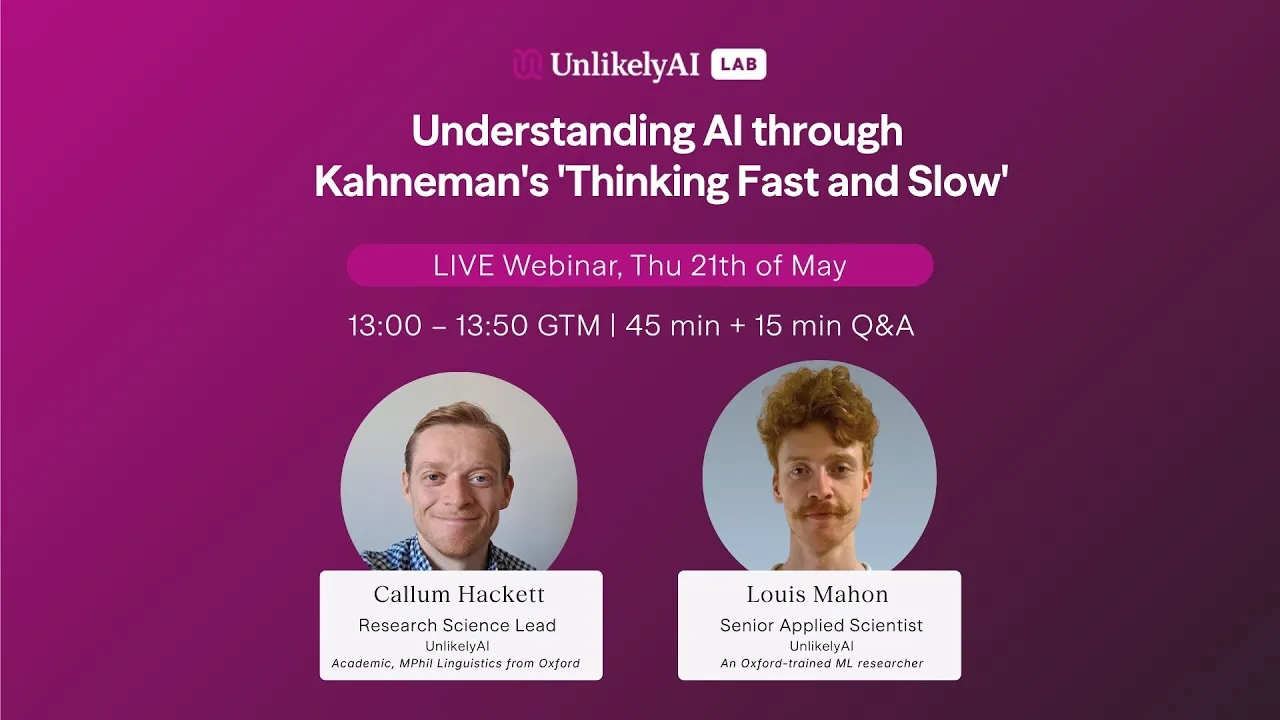
When we try to build machines that reason, we have only one fully worked example of a reasoning system to look at: ourselves. So it’s no surprise that AI research looks to cognitive science for design cues. Kahneman’s Thinking, Fast and Slow is one framework in human psychology that has been applied when designing and making sense of neurosymbolic AI systems, but does that analogy illuminate, or does it constrain?
In our latest UnlikelyAI webinar, Callum Hackett (Head of Research, UnlikelyAI) and Louis Mahon (Senior Applied Scientist, UnlikelyAI) wrestled with exactly that question. They took the analogy apart property by property and asked which ones hold up, which are borrowed for credibility, and what actually justifies hybrid AI architectures in practice.
The conversation covered:
• How AI has always borrowed from human and natural systems, and when those borrowings become fallacious
• What Kahneman actually said about System 1 and System 2, and why he thought AI research had misread him
• How IBM’s SOFAI and DeepMind’s AlphaGo handle the System 1 / System 2 split in practice
• Where the analogy breaks down when you compare it against real neural and symbolic systems
• Why the strongest case for neurosymbolic AI doesn’t need Kahneman at all
Below is a recap of the top takeaways, followed by the questions the conversation leaves open.
Top takeaways
1) AI has always borrowed from human cognition, but not every borrowing is sound
Neural networks were inspired by neuroscience symbolic AI from human compositional reasoning; reinforcement learning from behavioural psychology; and evolutionary computation from natural selection. Each borrowing has to be tested: is it doing real conceptual work, or is it just lending credibility to a design decision made on other grounds?
“”For any such inspiration, we should ask: is it being used as a thinking tool, a research framework, or is it perhaps a fallacious analogy?” — Callum Hackett”
2) Kahneman’s framework was a critique of rational agent models, and a warning about taking simplifications too literally
Kahneman won the Nobel for dismantling the assumption that humans are rational, selfish agents with stable preferences. Examples such as the bat-and-ball problem and Steve-the-librarian show how easily intuition can diverge from critical reflection. The deeper warning: oversimplified models of human reasoning have underwritten bad social and political decisions. The same risk applies to oversimplified models of machine reasoning.
“”Human mathematical thinking tends to be quite sloppy because we didn’t evolve for that kind of thinking.” — Callum Hackett”
3) System 1 and System 2 were never meant to be rigorous categories
Kahneman explicitly described them as characters, explanatory abstractions, not formal structures in the brain. Treating them as a clean architectural template is already a step beyond what the framework can carry. The most useful observation is the relationship between them: System 2 handles novel problems, but as we practice them, the ability gets offloaded to System 1. Familiarity, in other words, breeds the System 1 competence.
“”He actually describes them as characters. As if they were characters in a novel. They are explanatory abstractions developed to help us be reflective about the way we think.” — Callum Hackett”
4) The analogy in the context of real systems: AlphaGo and IBM’s SOFAI
IBM’s SOFAI runs a fine-tuned LLM as System 1 and symbolic planners as System 2, with a metacognitive agent deciding when to escalate. On planning benchmarks, the hybrid outperformed either component alone. AlphaGo is an older system (2016), but a major breakthrough at the time. It used a neural component (CNNs) to supply intuition for promising moves, and a symbolic component (MCTS) for lookahead. DeepMind framed it as a deep-learning triumph, but this is more an artefact of the history of its development than the nature of the system itself. Both neural and symbolic methods were crucial to AlphaGo’s success, the difference is just that the former had been around for decades, whereas the latter was the new missing piece that had just been unlocked.
“”DeepMind phrased it as: this is a big success for neural computation. Really, it was a success of a neurosymbolic system, a system that combined both of them.” — Louis Mahon”
5) When you actually test the mapping, most of it doesn’t hold
Walking through Kahneman’s properties: fast/slow, subconscious/conscious, automatic/deliberate, familiar/open-ended, heuristic/logical, only one (heuristic vs logical) is a genuine fit. The rest are partial at best and Kahneman himself thought AI research had taken his framework up in a confused way, particularly in treating System 1 as non-symbolic when human language understanding is plainly both intuitive and symbolic.
“”People are generally trying to leverage the analogy just because you get credibility for the association with a human cognitive framework, but people tend not to develop it too far.” — Callum Hackett”
6) The real case for hybrid systems isn’t cognitive, it’s practical
Real-world problems like interpreting regulation have both a precise logical core and a fuzzy natural-language surface. Neither paradigm handles both well alone. And capability isn’t the only axis: in regulated industries, explainability is often the deciding factor, which pulls the architecture toward symbolic components wherever a decision has to be defended downstream. The case for neurosymbolic AI stands on its own, it doesn’t need Kahneman.
“”There’s some core structure to the meaning, which is logical and precise. But the whole thing is expressed in natural language, which can be worded in lots of different ways. You have to deal with the fuzziness of that world as well.” — Louis Mahon”
Questions the conversation leaves open
The webinar closed with several open questions, which feels right for a framework being applied as widely as this one:
• Where does the signal to “think slow” come from? In Kahneman’s experiments, people happily accept their intuitive answers until someone external challenges them. What’s the equivalent prompt for an AI with no interlocutor?
• How do you decide when to think differently? If a hybrid system has both neural and symbolic components available, the choice of when to use which is itself a design problem one that often gets quietly absorbed into the architecture without being made explicit or auditable.
• To what extent is language symbolic? Is it at all possible to demarcate which aspects or instances of language use are symbolic, either in a human or AI? This also brings up the question of whether a linguistic symbol - something that stands for something else - is a different thing to the sort of symbol manipulated in computation.
• Is the field missing interpersonal cognition entirely? Kahneman’s framework lives inside one head. But a lot of human reasoning, especially explanation and justification, happens between people. No single-agent architecture obviously captures that, and in regulated decision-making it matters.
• Should we drop the Kahneman framing altogether? If the strongest case for hybrid AI rests on problem structure and auditability rather than cognitive emulation, the analogy may be costing more in confusion than it’s earning in credibility.
Want more from the UnlikelyAI Lab? Join our newsletter for research updates and case studies on trustworthy, explainable AI.